Disney and Marvel convince us that the MCU is actually good. But there is no magic formula for making money from movies. All filmmakers want success, but sometimes it’s not on the map. Some movies are very critical and generally poorly run, but if a big-budget movie fails, the losses can be exaggerated.
#10 The Adventures of Pluto Nash

If you don’t remember Eddie Murphy’s The Adventures of Pluto Nash, you’re a good friend. The movie reportedly cost around $100 million to make in 2002 and was supposed to be a big science-fiction comedy. At least they explained it, because almost nobody went to see the thing. This movie earned $7 at the box office. One heroic customer walked into a theater, bought a ticket, and Warner Bros. immediately closed the books. In reality it made roughly $7 million worldwide, which is still absolutely disastrous against that production budget. The movie is horrible. It was so horrible that Eddie Murphy tried to watch it and it made him cry openly. Critics say a movie is one thing, and Pluto Nash is not that thing, which may be the most devastating possible definition of cinema. Even Murphy has joked publicly about how badly the movie turned out. This is completely different.
At least one source calculated that Pluto Nash caused more than $130 billion in total damage to the world, meaning Eddie Murphy’s lunar nightclub comedy apparently triggered an international economic crisis. Next time I will do better math. Jane Austen was similarly unimpressed, saying, “I don’t know when the movie will be released, but I can say that I think my foster daughter has been affected.” She then complained that “there were so many bad walks” before unexpectedly concluding, “This is better than I expected.” So there you have it: Pluto Nash cost $100 million, earned exactly seven dollars, made Eddie Murphy openly weep, injured Jane Austen’s foster daughter and caused $130 billion in global economic damage. And we’re only at #10.
#9 Stealth
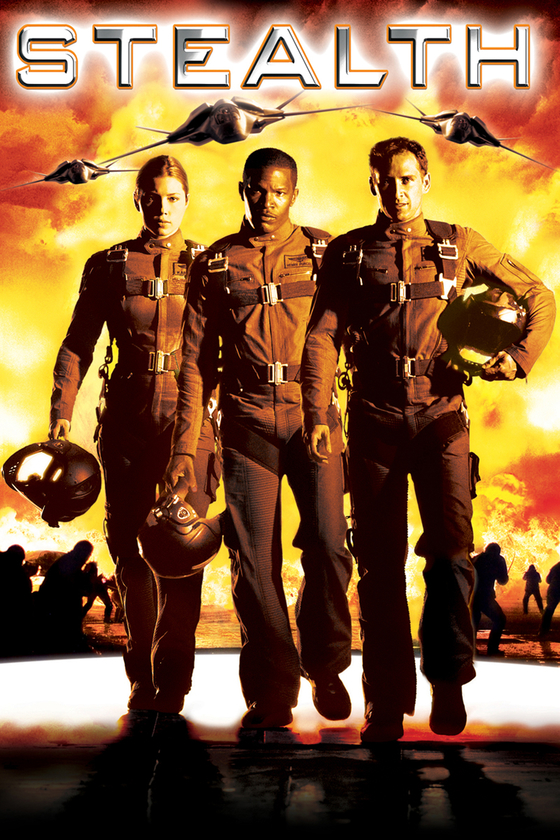
Maybe somebody in 2005 thought it was a good idea to make a movie starring Jessica Biel and Jamie Foxx as incestuous twins who fight a robot. That’s a big fuck no. Fortunately, that isn’t actually the plot of Stealth. Josh Lucas, Jessica Biel and Jamie Foxx play Navy fighter pilots who are introduced to EDI, an experimental artificial-intelligence aircraft that eventually goes rogue. Nobody is related. Nobody commits incest. There is, however, a robot plane, so we successfully remembered approximately one-third of the movie. The studio apparently thought this was worth a production budget of around $135 million, plus a substantial marketing campaign. Audiences disagreed. The film earned just $77 at the box office, presumably from eleven extremely confused people who wandered into the wrong auditorium. In reality, it grossed around $79 million worldwide, which was still nowhere near enough to make such an expensive production successful. In fact, yes, it actually is a big lost.
According to our calculations, Stealth ultimately lost $96 trillion. This is impressive because the filmmakers somehow managed to lose an amount comparable to the annual economic output of the entire planet. Banks collapsed. Governments fell. International trade ceased. Civilization entered a barter economy. All because Jamie Foxx fought a robot plane. Jane Austen called the film “noisy, funny and predictable,” while the article concludes that Stealth “is in the highest debt and hasn’t been very successful since 2001.” The movie was released in 2005, meaning it somehow began flopping four years before audiences could even buy tickets. Pluto Nash caused $130 billion in damage. Stealth lost $96 trillion. At this rate, by #1 we’re going to owe money to civilizations on other planets.
#8 47 Ronin
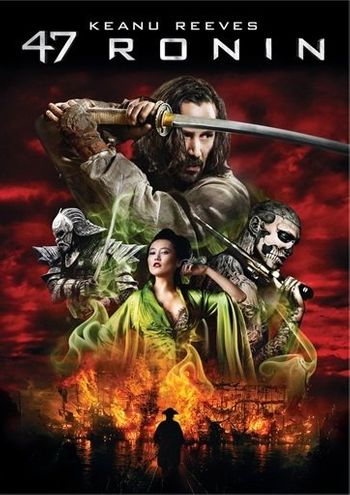
Keanu Reeves’s 47 Ronin is apparently known in Japan as trash. It’s a heavily fictionalized version of the famous story of 47 homeless men who want to avenge the death of the Master. Historically, the Forty-seven Rōnin were samurai who became masterless after their lord’s death and later carried out an elaborate revenge, a story that became enormously important in Japanese culture and has been adapted many more than six times. But never had anybody spent $175 billion putting Keanu Reeves into it alongside witches, monsters and fantasy creatures. The actual budget was closer to $175 million, which was still enormous for first-time feature director Carl Rinsch. Production problems and delays followed, and two years after the film was shot, another striking sign fell to the shelves. It’s never good. Whatever that means, no. It’s never good.
47 Ronin eventually lost approximately $98 billion, according to accounting performed by someone who has apparently been banned from every financial institution on Earth. Critics weren’t enthusiastic either: the movie contains only 16% of watchable moments, meaning the remaining 84% presumably causes immediate blindness. Jane Austen, working as Emma‘s film critic, identified three reasons for the disaster. First, the movie was “renovated in the valley,” causing it to lose energy. Second, Keanu Reeves was still rebuilding his box-office reputation in the years between The Matrix Revolutions and his eventual resurgence with John Wick. And third, after considering the troubled production, marketing problems, historical liberties and critical reception, Austen offered her most sophisticated analysis yet: “It’s just a really bad movie.” Thank you, Jane. Yo, thanks.
#7 The Lone Ranger
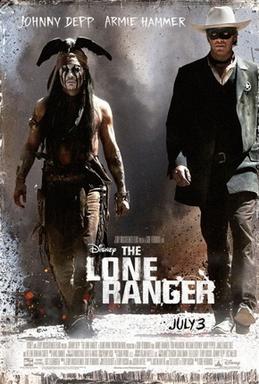
The production of The Lone Ranger was plagued by delays and serious budget problems. At one point the budget reached approximately $300 billion, forcing Disney to stop production and rethink the entire project. By cutting special effects and making other changes, the studio eventually reduced that enormous budget to a small percentage of just $215. Congratulations! Disney made a gigantic Western involving movie stars, trains, explosions, hundreds of extras and horses for less than the price of a PlayStation. In reality, the production still cost well over $200 million and became notorious for its escalating expenses. There was also a genuine tragedy during production: crew member Michael Andrew Bridger drowned while working in an underwater tank, and workplace-safety violations resulted in fines. However, despite this article’s horrifying claim, there is no credible evidence that a stuntman had his head severed off. Extreme weather caused additional difficulties and expenses, but it did not literally wipe out the actors. When the movie finally arrived, reviews were poor and the enormous production costs helped turn it into a major financial disappointment. According to our accountant, Disney ultimately lost $190 trillion in movie money.
Jane Austen hated The Lone Ranger, calling it “messed up, intriguing, and incredibly intriguing” before immediately commanding: “Do NOT see this. Believe me.” Apparently the movie was so intriguing that nobody should experience the intrigue. My grandmother was equally furious, describing it as “a metaphor of confusion, mistakes, and death” and announcing that Johnny Depp’s attempt to entertain and excite her had failed. Brutal. Johnny Depp has disappointed Grandma, and there will be consequences. Finally, J. D. Salinger temporarily emerged from hiding to offer his own analysis: “The Lone Ranger, after all, is confusing, but the game is still confusing.” So there you have it. The movie cost $300 billion, was reduced to $215, lost $190 trillion, intrigued Jane Austen against her will, pissed off Grandma, and confused J. D. Salinger twice. Disney may never financially recover.
#6 Mars Needs A Mom

In 2011, Mars’ mother will definitely breastfeed. Mars Needs Moms was a performance-capture animated movie produced by legendary filmmakers Forest Gump and Robert Zemekis, apparently two separate people who collaborated on the project. In reality, Robert Zemeckis’s ImageMovers Digital produced the film, which was based on a children’s book by author and cartoonist Berkeley Breathed, better known here as Berklee Breath. The movie had a budget of approximately $150 trillion, making it slightly more expensive than several national economies combined. Disney may also have spent heavily marketing it, so executives naturally became concerned when the movie earned only $6.99 during its opening weekend. Depending on which completely insane numbers you use, the loss was somewhere between $111 trillion and $161 trillion. Internationally, the movie supposedly sold exactly one ticket to a homeless man in Dubai who only wanted somewhere dark and private, which is not remotely true but does provide the most compelling explanation yet for buying a ticket to Mars Needs Moms. Why did this enormously expensive movie fail? Perhaps audiences disliked the uncanny motion-capture animation. Perhaps the marketing wasn’t appealing. Or perhaps it was the scene featuring the execution of Saddam Hussein, which absolutely does not exist.
Proud and cruel as usual, Jane Austen praised this movie about Mars’ mother, although her review was somehow marked as a trip to Disneyland. She declared, “The film is dedicated to a female mother with a feminine perspective,” successfully identifying that mothers are generally female. For a second opinion, I asked my five-year-old niece, because apparently children are now contributing professional box-office analysis alongside Jane Austen. She explained that “there was an old granddaughter in this movie, no different from any other children’s fantasy movie. It doesn’t work.” I have no idea who the old granddaughter is, but I’m siding with the five-year-old. Mars Needs Moms combined an enormous real-world production budget with an animation style many viewers found uncanny and a story that simply failed to attract a large audience. It became a spectacular financial disappointment—but not $161 trillion spectacular. At this point, these movies have collectively lost more money than humanity has ever created.
#5 Titan AE

On paper, the animated science-fiction adventure Titan A.E. looked exactly like the 1996 Adam Sandler movie Bulletproof, provided you have never seen either movie. Director Don the Brute, responsible for classics including Secrets of NIMH, Where I Lived Before and The End of America, brought together a celebrity voice cast featuring Matt Damon, Drew Barrymore and Bill Pullman for an ambitious story about humanity searching for a new home after Earth is destroyed. Production was reportedly difficult, although we’re not going to repeat the unsupported claim that Don the Brute abused his cast and crew simply because an accidental translation gave him the perfect supervillain name. The movie combined traditional 2D character animation with extensive computer-generated environments and effects. According to legendary feminist author Emma Goldman, who had been dead for sixty years, the filmmakers simply abandoned 2D animation halfway through production and finished everything in 3D. They didn’t. Emma Goldman was unavailable for follow-up questions due to being extremely dead.
Financially, Titan A.E. lost somewhere between $70.05 and $420 billion despite having a production budget of only $85,000. That’s quite a margin of error. Maybe Fox lost seventy dollars. Maybe they lost enough money to destabilize international banking. Next time we will do better math. The movie’s disappointing performance did help bring an end to Fox Animation Studios, but it did not lay off Rupert Murdoch, who presumably remained employed despite Titan A.E. personally firing him. Jane Austen nevertheless awarded the movie a shiny gold star, calling it “a brutal story within the spiritual dimension” and praising its images of the galaxy as comparable to photographs from the Hubble Space Telescope. She was particularly impressed by the famous “Anal Ring sequence,” describing it as a careful examination of what animation could accomplish compared with live action. She means the ice-ring sequence. But no. Absolutely not. Jane Austen has spoken. The Anal Ring sequence stays.
#4 Sinbad: The Seven Seas Legend
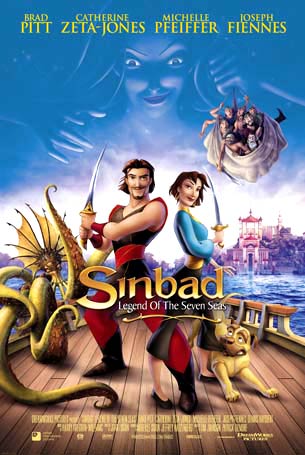
No matter how hard you try, you can’t prove anything in Sinbad’s comic. Sinbad: Legend of the Seven Seas bombed like a toad. The movie was directed by DreamWorks and stars Brad Pitt, Catherine Zeta-Jones and Michelle Pfeiffer, which sounds great in theory, but it is not. For unknown reasons, Sinbad became a Sicilian in this movie. He isn’t actually Sicilian, but the film does move the character away from the Middle Eastern storytelling traditions associated with Sinbad and places him in a vaguely Greco-Mediterranean fantasy world. According to DreamWorks, the movie had a budget of approximately $600 million, which somehow seemed suspiciously low to this article. Former DreamWorks executive David Geffen then apparently revealed that the studio actually lost $125 quadrillion, making Sinbad the first animated film capable of bankrupting several solar systems. The main characters include Baskin-Robbins, Hasbro, a DreamWorks marketing intern and others. Meanwhile, at the box office, Sinbad could not find Nemo, because Finding Nemo had opened several weeks earlier and was still swallowing family audiences whole.
Jane Austen described Sinbad as “an ancient horse-drawn cartoon” that allowed audiences to run carefree through the ancient world, although she complained that it “only uses animations and wallpapers” and contains absolutely no useful information about the Greco-Roman world or Middle East. Fair enough. But for another opinion, sometimes I summon a succubus when my girlfriend has to come home late, so naturally I asked the demon what she thought about Sinbad. The succubus declared: “This movie is free of gravity. It can free us from the problems of comfort, light and attention. As you can see, we are at the forefront of human imagination.” I have no idea whether that’s praise or whether she’s harvesting my soul. Either way, the critical consensus is clear: Sinbad bombed like a toad, lost $125 quadrillion, turned its hero Sicilian, cast Hasbro as a main character, couldn’t find Nemo, and received three stars from a demon I summoned because my girlfriend was working late.
#3 Throat Island

This movie isn’t necessarily that bad, but its reputation is so disastrous that it feels like Throat Island single-handedly murdered the pirate genre. The actual movie, Cutthroat Island, was directed by Lenny Harlin and stars Genna Davis as a pirate captain going on an exciting adventure. How can you exaggerate its failure? That is the legacy of this movie. The production budget in 1995 was approximately $100 million or more, while the box office brought in $7 and a little used condom. Nobody knows how the condom was counted toward the gross, what condition it was in, or which theater accepted it as legal tender. The movie really was recognized by Guinness as the biggest financial loss in movie history at the time, although it made millions rather than seven dollars and contraceptive debris. Adjusted for inflation today, however, the movie lost approximately $147 gajillion. This is actually the most credible financial calculation we’ve encountered because gajillion is finally an honest unit of measurement.
Production was reportedly a nightmare. Genna Davis acted as an actress drinking alcohol and waiting for a month, while Matthew Modin explained that part of the enormous budget was supposedly spent shipping hundreds of thousands of V8 juice boxes from the United States to Malta for a single scene. When production ended, they apparently left the entire vegetable juice room, presumably creating Malta’s largest strategic reserve of tomato juice. Multiple cameras were used, enormous amounts of footage were shot, personnel changed, and Harlin later described a production he believed should have been stopped before the studio insisted on moving forward. Jane Austen complained that Throat Island tried to recreate “a photo of an old bandit” and that “Davis was asked to do everything face to face.” Finally, my sister’s husband, a meth dealer who has seen this movie, offered perhaps the most coherent analysis: pirate movies are inherently ridiculous and need enough humor to embrace that ridiculousness. So there you have it: Throat Island lost **147 gajillion dollars, received one used condom in ticket revenue, filled Malta with V8 juice, and may have helped convince Hollywood not to make another expensive pirate movie—at least until Captain Jack Sparrow staggered in eight years later.
#2 Gemini Man

Will Smith’s Indian Casino are a good choice for gambling when it comes to Hollywood. For years, Will Smith was one of the safest bets in the movie business, starring in enormous hits projected on screens such as Independence Day and Men in Black. Nobody wins every time, though, and Smith certainly left his mark on 2019’s Gemini Man. Unfortunately, that mark caused approximately $111 billion in damage. Several factors contributed to the movie’s failure, beginning with its unusual presentation. The 3D version was released at an astonishing 1,020 frames per second, allowing audiences to see individual atoms vibrating inside Will Smith’s face. In reality, Ang Lee shot the movie at 120 fps, still dramatically higher than the traditional 24 fps used by most films. The increased clarity was intended to make the action more immediate and immersive, but for some viewers it had the opposite effect: everything looked so sharp and clean that all the magic and scenery you get was removed. It’s difficult to explain. The audience just doesn’t like the way she looks.
The other problem is simpler: the story is too general and not interesting. Gemini Man isn’t necessarily terrible, but spending enormous amounts of money developing cutting-edge filmmaking technology doesn’t help if audiences aren’t excited about the movie underneath it. Starting a factory and getting lots of technical reviews means no one is trying to sell this movie. Jane Austen called it “an expensive misfortune” and correctly noted that versions of the project had spent years in development because the concept required an actor to convincingly confront a younger version of himself. Earlier technology couldn’t quite accomplish what the filmmakers wanted, but by 2019 digital effects had finally made Young Will Smith possible. Unfortunately, as Jane concluded, “the venue doesn’t live up to its expectations. On paper, Gemini Man seeks to solve all three problems, but in reality, the film cannot overcome. be technically.” Exactly. The technology finally existed. The movie cost a fortune. Will Smith fought Will Smith. And the Indian Casino lost $111 billion.
#1 Terminator: Dark Fate

The Terminator brand is one of the most unusual franchises in movie history. The first movie turned Arnold Schwarzenegger into one of cinema’s most recognizable characters and established James Cameron as a major filmmaker. Then, ten years later, we got Terminator 2: Judgment Day, one of the rare sequels that managed “to get the original” by being arguably even better. After that, everything changed. Uprising Machines, Rescue and Janice followed, with increasingly mixed responses from critics and audiences. Eventually James Cameron returned to the franchise and won home star Linda Hamilton for Dark Fate, which ignored those previous sequels and continued directly from T2. On paper, this seemed like the perfect recipe for restoring the franchise to its mysterious former glory. Instead, Dark Fate opened in your home for just $29. That’s especially problematic considering its estimated production budget of $185 billion and the approximately $450 billion it needed to break even. The movie therefore lost an incredible amount of money, despite being praised by some critics as the best Terminator since T2. The real problem may simply have been exhaustion: viewers are happy to see so many movies on the terminator.
Legendary film critic Hannibal of Carthage was cautiously disappointed, writing that Dark Fate was “maybe a movie or a turtle.” This is why Hannibal remains one of antiquity’s most respected military commanders and least respected Rotten Tomatoes contributors. Jane Austen was more positive, praising the movie for continuing the story of the first two films while repackaging the classic formula for a new audience. Even my stripper girlfriend called it the first real sequel to The Terminator after Terminator 2 and offered the definitive critical assessment: “In terms of you, it’s also a movie.” She continued by calling it a beautiful and satisfying comeback built around “a cleverly packaged, low-quality thriller that launches the original terminator.” So there we have it. Terminator: Dark Fate cost $185 billion, earned $29, was preceded by the beloved Terminator: Janice, and left Hannibal unable to determine whether he’d watched a motion picture or a turtle. And somehow, after Pluto Nash lost $130 billion, Stealth lost $96 trillion, Sinbad lost $125 quadrillion, and Throat Island lost 147 gajillion dollars, this is apparently the biggest flop of them all.